
David Bidwell

Email: david.bidwell@ubc.ca


A photo of people on a beach viewing the McDougall Creek wildfire from across Okanagan Lake.

People sit on an Okanagan Lake beach viewing a distant wildfire.

How wildfires spread is more variable and unpredictable than Canada’s standard models assume, new research from UBC Okanagan data scientists shows. 

Ladan Tazik, lead author of a new study in Fire and UBC Okanagan doctoral student, used advanced computer vision tools to capture fire behaviour with a level of detail that wasn’t possible even a few years ago.  

Her work sheds light on the random elements of fire movement—information that could reshape how fire behaviour is modelled and forecasted in an era of worsening wildfire seasons. 

“Image processing techniques let us quantify fire behaviour in real time, including the parts that don’t follow consistent patterns,” says Tazik“By capturing the randomness in how fires spread, we can build models that better reflect reality and help improve decision-making during active fire events.” 

Tazik led the design, analysis and modelling that form the backbone of the study.  

She used the “Segment Anything Model”, a state-of-the-art AI tool, to extract fire perimeters from experimental burn videos frame by frame to study fire spread dynamics.  

This allowed her to study directional fire spread on sloped terrain without assuming the fire behaves predictably or spreads in a simple line. 

Her analysis confirmed something firefighters may know instinctively: fires race uphill. But when she compared her measurements with the values used in Canada’s official Fire Behaviour Prediction System, the numbers didn’t always line up.  

Real fires often moved faster, and the influence of slope wasn’t consistent from place to place. 

She tested the method on ponderosa pine and Douglas fir fuels often used in fire research. 

This highlights that small differences in fuel, wind and terrain can add to the unpredictability of fire and introduce important variations in how it spreads.  

Even under nearly identical conditions, the flames didn’t behave the same way twice. 

In practical terms, that means most fire spread is shaped by randomness—far more than today’s deterministic models capture. 

“These results show that we need to pair every spread estimate with a measure of uncertainty,” Tazik explains. “Simply multiplying by a slope factor isn’t enough. Fire is dynamic, and our models should acknowledge that.” 

Research supervisor Dr. W. John Braun says the project demonstrates how emerging computer vision tools can transform wildfire science.  

“Tazik proposed innovative ways to tackle this difficult modelling problem,” he says. “Her work shows how high-resolution perimeter data and advanced modelling can help us understand the real variability in fire behaviour. That’s essential if we want to move toward more probabilistic, data-driven prediction systems.” 

The study also included contributions from Dr. John R.J. Thompson, Assistant Professor of Data Science, Mathematics and Statistics, as well as other partners who provided the experimental and field video datasets.  

While the fuel experiments supported the research, Tazik alone led the segmentation and modelling components. 

Tazik says the next step is to expand the approach to more fuel types and fire conditions and use airborne or satellite imagery to study fire spread dynamics.  

With more Earth observation and remote sensing tools available, she sees an opportunity to build models that better capture wildfire dynamics while embracing the inherent uncertainty of fire, rather than smoothing it away. 

“Fires don’t behave perfectly,” she says. “Our tools shouldn’t pretend they do.” 

The post AI-powered vision gives meaning to wildfire chaos appeared first on UBC's Okanagan News.

A photo of a UBCO street sign that reads "Research Road" as well as the syilx translation.

A newly installed nsyilxcn street sign on UBC Okanagan’s campus features a QR code that links to student-created audio recordings, helping the broader campus community learn the pronunciation and meaning of Syilx place names.

UBC Okanagan is deepening its commitment to Indigenous language revitalization by adding voices to on-campus nsyilxcn street signs in Kelowna.  

New QR codes attached to the signposts link to an online pronunciation guide featuring audio recordings created by students in the Bachelor of Nsyilxcn Language Fluency program. 

“The nsyilxcn language is beautiful and descriptive, which the Syilx people recognize as being generated and given to the people directly from the land,” master’s student Ashley Gregoire writes in a blog post about the project. 

“The audio for these signs is equally important, as it provides the opportunity for people to learn proper pronunciation of each word while familiarizing themselves with the sounds of the nsyilxcn language, which is, ultimately, the sounds of this beautiful land.” 

The initiative builds on UBCO’s long-standing partnership with the Okanagan Nation Alliance (ONA) and the En’owkin Centre to honour the Syilx Okanagan Nation and promote everyday use of the Nsyilxcn language. 

“Language illustrates a connection between people and a place,” says Dr. Christine Schreyer, Professor of Anthropology in the Department of Community, Culture and Global Studies 

“By hearing nsyilxcn spoken aloud, everyone on campus can experience the sounds of the language while learning the meaning behind these words. The recordings are a connection to the Syilx Okanagan Nation, the people and the land.” 

Since 2010, UBCO has displayed nsyilxcn translations alongside English names on its campus street signs—the first initiative of its kind in the region.  

The project was expanded in 2022 with newly designed signage in partnership with the ONA and En’owkin Centre, featuring a distinctive blue-green colour inspired by Kalamalka Lake and the ONA’s bear-and-salmon logo. 

Now, the addition of QR codes lets students, faculty, staff and visitors scan each sign with their phones to hear the nsyilxcn pronunciation.  

The recordings were developed by Bachelor of Nsyilxcn Language Fluency students as part of an Endangered Language Documentation and Revitalization course, taught by Dr. Schreyer.  

The interactive feature supports UBCO’s truth and reconciliation commitments and its goal to make the Syilx language visible and audible across campus.  

Visitors can explore the 11 sign locations through a downloadable map at ok.ubc.ca/about/indigenous-engagement/nsyilxcn-street-signs. 

The post Syilx students give nsyilxcn a voice on UBC Okanagan streets appeared first on UBC's Okanagan News.

A photo of a UBCO street sign that reads "Research Road" as well as the syilx translation.

A newly installed nsyilxcn street sign on UBC Okanagan’s campus features a QR code that links to student-created audio recordings, helping the broader campus community learn the pronunciation and meaning of Syilx place names.

UBC Okanagan is deepening its commitment to Indigenous language revitalization by adding voices to on-campus nsyilxcn street signs in Kelowna.  

New QR codes attached to the signposts link to an online pronunciation guide featuring audio recordings created by students in the Bachelor of Nsyilxcn Language Fluency program. 

“The nsyilxcn language is beautiful and descriptive, which the Syilx people recognize as being generated and given to the people directly from the land,” master’s student Ashley Gregoire writes in a blog post about the project. 

“The audio for these signs is equally important, as it provides the opportunity for people to learn proper pronunciation of each word while familiarizing themselves with the sounds of the nsyilxcn language, which is, ultimately, the sounds of this beautiful land.” 

The initiative builds on UBCO’s long-standing partnership with the Okanagan Nation Alliance (ONA) and the En’owkin Centre to honour the Syilx Okanagan Nation and promote everyday use of the Nsyilxcn language. 

“Language illustrates a connection between people and a place,” says Dr. Christine Schreyer, Professor of Anthropology in the Department of Community, Culture and Global Studies 

“By hearing nsyilxcn spoken aloud, everyone on campus can experience the sounds of the language while learning the meaning behind these words. The recordings are a connection to the Syilx Okanagan Nation, the people and the land.” 

Since 2010, UBCO has displayed nsyilxcn translations alongside English names on its campus street signs—the first initiative of its kind in the region.  

The project was expanded in 2022 with newly designed signage in partnership with the ONA and En’owkin Centre, featuring a distinctive blue-green colour inspired by Kalamalka Lake and the ONA’s bear-and-salmon logo. 

Now, the addition of QR codes lets students, faculty, staff and visitors scan each sign with their phones to hear the nsyilxcn pronunciation.  

The recordings were developed by Bachelor of Nsyilxcn Language Fluency students as part of an Endangered Language Documentation and Revitalization course, taught by Dr. Schreyer.  

The interactive feature supports UBCO’s truth and reconciliation commitments and its goal to make the Syilx language visible and audible across campus.  

Visitors can explore the 11 sign locations through a downloadable map at ok.ubc.ca/about/indigenous-engagement/nsyilxcn-street-signs. 

The post Syilx students give nsyilxcn a voice on UBC Okanagan streets appeared first on UBC's Okanagan News.

A close-up photo shows a cyclist commuting in an urban environment

A study co-authored by UBC Okanagan Associate Professor Dr. Mahmudur Fatmi and doctoral student Bijoy Saha uses Okanagan travel-diary data to model destination choices across full bike “tours.”

Cyclists often stay close to home, take shorter routes when making multiple stops and favour areas with connected bike lanes and nearby amenities, according to new research from UBC Okanagan’s School of Engineering.   

The study, co-authored by Dr. Mahmudur Fatmi, Associate Professor of Civil Engineering, and doctoral student Bijoy Saha, appears in the Journal of Transport Geography and uses Okanagan travel-diary data to model destination choices across full bike “tours”—or chained trips that start and end at home.  

“Planners often know popular routes. We’re showing where people stop and how that changes as a day gets more complex,” says Saha. “If you want people to link a café, park and store by bike, connect those areas with safe infrastructure and more destinations within reach.” 

Much of the existing research focuses on single trips. Saha’s model accounts for how cyclists plan their days, which can include things like a coffee on the way to work, groceries on the way back, and limits like time, terrain and stamina.   

First, the model filters destinations that are too far or demanding for a cyclist to reach. Then it uses a statistical approach to understand why riders choose different places and what attracts them to certain destinations.  

The study found that cyclists usually choose nearby destinations, travel farther on simple one-stop tours, and take shorter routes when they have more stops.   

“Cyclists often make multiple stops before reaching their destinations, such as picking up coffee or stopping for groceries,” Saha says. “This makes it necessary to recognize this ‘spatio-temporal’ dependency of travel and plan routes that connect them. Our model captures that reality.”   

Built-environment factors such as the number of nearby activities and the ratio of bike lanes to road length increase the odds a rider will choose an area.    

The model was trained on data from the 2018 Okanagan Travel Survey, a region-wide 24-hour diary of trips across Kelowna, West Kelowna, Vernon, Peachland and Lake Country.    

Saha, who conducts his research in UBCO’s integrated Transportation Research lab, says the goal is practical: help cities place bike lanes, end-of-trip parking and services where cyclists are likely to go.  

The work comes as BC continues to support active transportation networks with provincial grants and new funding adding up to roughly $135 million in capital support since 2023.    

Some policy takeaways from the study include:  

  • Add destinations near homes and employment areas; density draws riders.   
  • Connect clusters with continuous bike lanes; a higher bike-lane-to-road ratio boosts attractiveness.   
  • Expect telecommuters to bike farther for recreation and errands; plan secure parking at parks, cafés and community hubs.

Dr. Fatmi says the study strengthens a part of transportation planning that has often been overlooked.   

“Most demand models are still centred on vehicles, which means they don’t always reflect how cyclists make decisions,” he says. “By improving how we model cyclists’ destination choices, planners get more realistic and accurate inputs. That allows cities to target the right connections, invest more equitably across neighbourhoods and support genuine shifts toward active travel.  

“This work is also feeding into our larger effort to build a full model that evaluates both vehicle and non-vehicle travel, and how each affects traffic and the environment.”  

The post Student maps where cyclists really go—and why it matters for city planning appeared first on UBC's Okanagan News.
Architectural drawing showing a single-storey modular home called EcoHaven, with timber framing, sloped rooflines and surrounding vegetation. The image highlights the home’s compact layout and design features meant to improve wildfire resistance and energy efficiency.

A rendering of EcoHaven, a modular, wildfire-resilient and net-zero home concept created by UBC Okanagan and Thompson Rivers University students for the 2024 US Department of Energy Solar Decathlon.

Two UBC Okanagan engineering students are transforming classroom research into a practical tool for communities facing increasing wildfire risk. 

Under the supervision of Dr. Qian Chen, Miracle Kabano and Samantha Krieg co-authored a new paper outlining the Wildfire-resilient and Sustainable Evaluation Framework for British Columbia (WiSE-BC).  

The study appears in Lecture Notes in Civil Engineering and builds directly on the students’ earlier success designing EcoHaven, a modular home that won international recognition for wildfire resilience and energy efficiency. 

The EcoHaven project—developed in collaboration with Thompson Rivers University faculty Dr. Dale Parkes and Dr. Hossein (Sayed) Banitabaei, along with a multidisciplinary student team and industry partners—earned second place in the US Department of Energy’s 2024 Solar Decathlon Design Challenge 

Designed for Honour Ranch, a retreat near Ashcroft, BC, that supports veterans and first responders, EcoHaven combines wildfire-resistant materials, net-zero energy systems and affordability suited to BC communities. 

When Dr. Chen and her students later developed WiSE-BC, they used EcoHaven as a test case to evaluate the framework’s real-world potential.  

WiSE-BC applies the analytical hierarchy process, a structured decision-making method that allows scalability and adaptability depending on project size and stakeholder priorities. This makes it suitable for both single-family builds and community-scale planning. 

The results showed that WiSE-BC can help builders and designers identify trade-offs early, balancing emissions, cost and resilience at the concept stage.  

In practical terms, that means reducing design time and construction costs while improving sustainability and fire-safety outcomes. 

“With WiSE-BC, we wanted to explore and bring attention to an industry gap of both wildfire resilience and sustainability in design,” says Kabano. “Presenting our research at the Canadian Society for Civil Engineering conference was an incredible opportunity to help BC communities and developers make better design decisions in the early stages of a project.” 

“British Columbia urgently needs housing that can withstand climate extremes,” adds Dr. Chen, Assistant Professor of Civil Engineering. “WiSE-BC provides a roadmap for sustainable design that can be adopted by builders today, not years from now.” 

Krieg says leading the EcoHaven project and co-authoring WiSE-BC revealed how student-driven collaboration can have lasting changes. 

“It showed me the material impact that students can have on the world when they work together and strive for something greater,” she says. “By translating that work into research publications that offer practical solutions for industry, we hope to inspire others to build better in BC.” 

She adds that the experience shaped her career ambitions. 

“It inspired me to pursue a doctorate and continue investigating the intersection of sustainability and disaster resilience,” she says.  

The same student research group is now developing two additional papers based on the EcoHaven design and a related project from the previous year. As housing demand and wildfire threats continue to rise, the team hopes WiSE-BC and its successors will guide municipalities, homebuilders and policymakers toward practical, evidence-based design solutions. 

The post Student innovation connects wildfire resilience, safety to home design appeared first on UBC's Okanagan News.

A bird's eye view shows rows of shipping containers stacked in a shipping yard next to a large ocean.

UBC Okanagan engineers have created an AI-based framework to help schedule orders, plan production and manage inventory under extreme conditions.

As global supply chains continue to strain under trade tensions, natural disasters and pandemics, researchers at UBC Okanagan’s School of Engineering have created an artificial intelligence-based framework to help organizations build resilience efficiently and cost-effectively.

The study, published in Computers & Operations Research, presents an AI model that helps organizations make better decisions when facing uncertainty.

By combining operations research, machine learning and AI, the framework helps leaders decide how to schedule orders, plan production and manage inventory when conditions shift unexpectedly.

“Resilience is often discussed in broad terms, but our framework translates it into measurable financial decisions,” says Dr. Mahsa Mohammadi, a lecturer in the School of Engineering.

“It helps decision-makers evaluate which strategy—whether multi-sourcing, consignment inventory or long-term contracts—delivers the best improvement in service level per dollar spent, even when tariffs, delays or demand changes come into play.”

The team, which includes Dr. Babak Mohamadpour Tosarkani, Assistant Professor of Engineering, tested the model through a series of computer simulations that introduced global disruptions such as supplier shutdowns, tariff hikes and shipping delays. 

Their analysis showed that businesses that invest in diverse suppliers and coordinated inventory management reduced disruption costs by nearly 30 per cent and improved recovery time more than those reacting after problems occurred. 

Setting aside just 10 to 15 per cent of a company’s budget to resilience measures—such as shared backup contracts or local production—significantly reduced overall risk. 

Beyond business applications, the framework offers valuable insights for policymakers and funding agencies. 

“Public investments yield the greatest results when directed toward the supply chain elements most at risk of failure,” says Dr. Tosarkani. “Our model helps identify vulnerable components, suppliers or transport links, and guides decision-makers toward interventions that prevent system-wide disruptions.”

The findings also highlight how common cost-cutting strategies—like bulk purchasing during tariff uncertainty—can actually inflate inventory costs.

Instead, the researchers suggest balancing purchasing policies with adaptive inventory management and greater data sharing among supply chain partners.

“Resilience should be viewed as a strategic strength, not an added cost,” adds Dr. Mohammadi. “By using AI and optimization, organizations can measure how prepared they are and make stronger, evidence-based investment decisions.”

The post UBC Okanagan research offers playbook for supply chain resilience appeared first on UBC's Okanagan News.

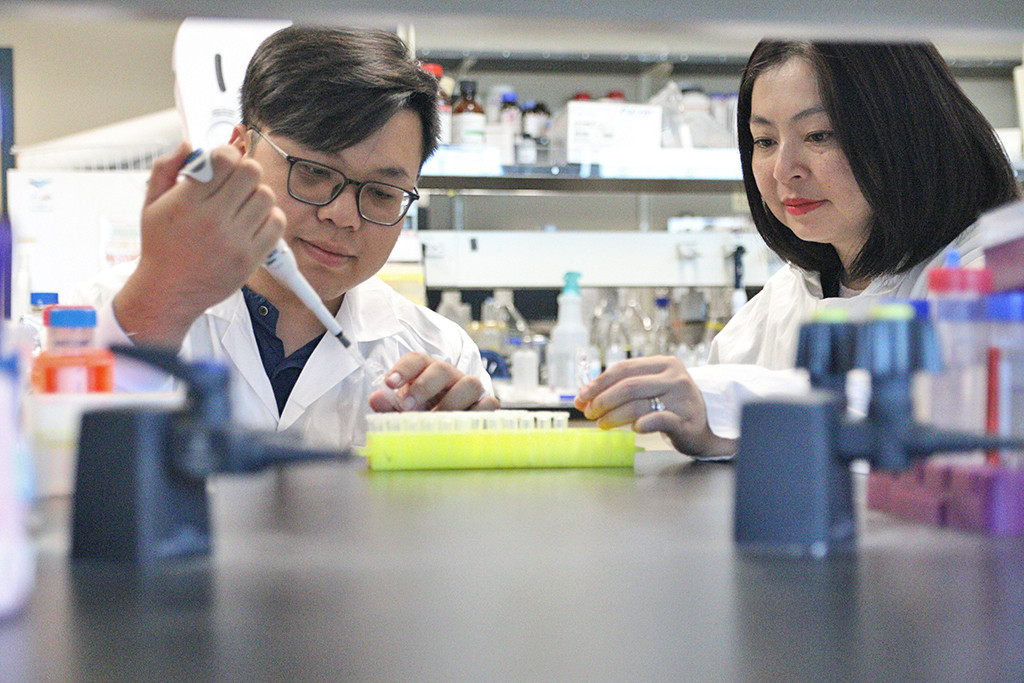
Two researchers in a laboratory setting: doctoral student Tuan-Anh Nguyen on the left and Dr. Thu-Thuy Dang examining plant samples. They are conducting research on how tropical trees produce mitraphylline, a rare compound with potential anti-cancer properties at UBC Okanagan.

UBC Okanagan doctoral student Tuan-Anh Nguyen, left, and Dr. Thu-Thuy Dang examine plant samples in their lab. Their research has uncovered how tropical trees produce mitraphylline, a rare compound with potential anti-tumour properties.

Researchers at UBC Okanagan have uncovered how plants produce mitraphylline, a rare natural compound that may help fight cancer. 

Mitraphylline belongs to a small group of plant molecules called spirooxindole alkaloids.  

These compounds have unusual “twisted” ring structures and are known for their strong effects, like fighting tumours and inflammation.  

Despite their promise, the molecular process that plants use to make spirooxindoles remained a mystery. 

That changed in 2023, when Dr. Thu-Thuy Dang’s research group in the Irving K. Barber Faculty of Science found the first plant enzyme that can twist a molecule into the spiro shape.  

“This is similar to finding the missing links in an assembly line,” says Dr. Dang, UBC Okanagan Principal’s Research Chair in Natural Products Biotechnology. “It answers a long-standing question about how nature builds these complex molecules and gives us a new way to replicate that process.” 

Building on that breakthrough, doctoral student Tuan-Anh Nguyen led the effort to identify a pair of enzymes—one that sets up the molecules’ 3D configuration and another that twists it into mitraphylline. 

Natural compounds are often found in very small amounts in plants, making them difficult or costly to reproduce in the lab. Mitraphylline is one such example: it occurs only in trace amounts in tropical trees like Mitragyna (kratom) and Uncaria (cat’s claw), members of the coffee family.  

By identifying enzymes that build and shape mitraphylline, researchers now have a roadmap for producing it and related compounds in sustainable ways. 

“With this discovery, we have a green chemistry approach to accessing compounds with enormous pharmaceutical value,” says Nguyen. “This is a result of UBC Okanagan’s research environment, where students and faculty work closely to solve problems with global reach.

“Being part of the team that uncovered the enzymes behind spirooxindole compounds has been amazing,” he adds. “UBC Okanagan’s mentorship and support made this possible, and I’m excited to keep growing as a researcher here in Canada.” 

The project is the result of collaboration between Dr. Dang’s lab at UBC Okanagan and Dr. Satya Nadakuduti’s team at the University of Florida.  

The work was supported by Canada’s Natural Sciences and Engineering Research Council’s Alliance International Collaboration program, the Canada Foundation for Innovation, and the Michael Smith Health Research BC Scholar Program. Support also came from the United States Department of Agriculture’s National Institute of Food and Agriculture. 

“We are proud of this discovery coming from UBC Okanagan. Plants are fantastic natural chemists,” Dr. Dang says. “Our next steps will focus on adapting their molecular tools to create a wider range of therapeutic compounds.” 

The post Researchers reveal how plants make anti-tumour drugs appeared first on UBC's Okanagan News.

A large leopard with golden fur and dark rosette spots stands alert in a sun-dappled forest. A thick black tracking collar encircles its neck. Its bright eyes look forward, ears pricked, as dappled sunlight filters through leafy branches above and dense green undergrowth surrounds its powerful body.

This collared jaguar was among the animals followed in the international study on wildlife movement patterns.

Cats and dogs may share our homes, but their wild relatives have moved through the world very differently for tens of millions of years. 

That’s one conclusion of a new study by a team of global researchers, including at UBC Okanagan, published today in Proceedings of the National Academy of Sciences.  

The research reveals that canids—wolves, coyotes and foxes—follow dense, predictable paths across their territories, while felids such as cougars, leopards and lynx tend to move in a more scattered way. 

“Cats and dogs split into separate species about 45 million years ago, and they’ve never looked back,” says Dr. Michael Noonan, Assistant Professor of Biology at UBC Okanagan’s Biodiversity, Resilience and Ecosystem Services (BRAES) Institute. “We can still see that divergence in how they move through their environments today.” 

The study analyzed GPS data from more than 1,200 animals across 34 species and six continents, using physics-based models to map “routeways,” or travel lines that animals reuse.  

On average, canids displayed 15 to 33 per cent more routeways than felids, even when living in the same areas. 

The differences may come from their diets, hunting styles and social behaviours. Canids often chase their prey, are omnivores and highly social, while felids hunt alone and are strict carnivores.  

Those traits may also relate to another long-debated question: are dogs smarter than cats? 

The short answer is no. The study wasn’t looking into intelligence in the modern understanding. Instead, the research supports long and poorly understood differences. 

“We didn’t test intelligence directly, but the results line up with existing psychology research showing canids have stronger spatial working memory,” says Noonan. “It’s not that dogs are smarter overall—they just seem wired to remember and reuse travel routes, while cats navigate space differently.” 

The findings carry clear conservation lessons. Canids’ reliance on predictable routes makes them more vulnerable to roads and barriers, but also more likely to benefit from wildlife crossings.  

In contrast, felids’ diffuse movements make them harder to protect with a single structure, but it may also help them hunt better in their smaller home ranges. 

“In British Columbia and Alberta, forestry and energy projects create roads and seismic lines that help canid movement, which can affect prey animals like caribou,” says Dr. Adam Ford, Canada Research Chair in Wildlife Restoration Ecology at UBCO and a study co-author. “Understanding these patterns is essential for effective conservation planning.” 

The project also highlights the collaborative and interdisciplinary strengths of UBC Okanagan researchers. Experts in biology, physics and statistics worked with more than 100 international partners, to create models that apply physics principles to wildlife movement. 

With GPS tracking often costing about $10,000 per animal, the project relied on a rare culture of global data sharing. 

“This is another great example of how scientists in the Okanagan are helping answer global questions in animal movement,” adds Noonan. “By combining ecology with tools from physics, we can find patterns that apply across species, continents and millions of years of evolution.” 

The post Global study maps how wild dogs follow patterns, wild cats roam free appeared first on UBC's Okanagan News.

Two researchers are silhouetted beside a large screen covered in blue and white patterns meant to represent the stars.

Dr. Megan Smith and Dr. Gao Yujie take in the All the Stars We Cannot See project at UBCO’s Critical Future Studio/Lab.w

What: SCI_ART: Art, Science and Technology Symposium
Who: A symposium hosted at UBC Okanagan, featuring international artists and researchers exploring bio-art, AI and sustainable practices
When: Tuesday, October 7 and Wednesday, October 8, from 9 am to 8:30 pm
Where: UBCO’s Critical Future Studio/Lab, Innovation Annex 1, 3505 Spectrum Court, Kelowna

When art, science and technology come together, the doors to possibility open widely. 

Next month, UBC Okanagan will host a two-day symposium where international artists will discuss the state of art, science and technology in today’s ever-changing world. 

The event will explore how creativity and innovation can shape our understanding of the world, explains Dr. Suzie Currie, UBCO Vice-Principal and Associate Vice-President, Research and Innovation. 

“We’re thrilled to welcome some of the world’s leading artists and scholars to SCI_ART,” says Dr. Currie. “Innovation happens when ideas are tested, challenged and reshaped. This symposium embodies innovation by challenging our perspectives on how science, technology and art come together to offer solutions to today’s global crises. Our faculty do this work every day through innovative research and creative activity that can change the world.” 

The SCI_ART: Art, Science and Technology Symposium features panel discussions, artist talks, performances, screenings and exhibitions that explore cutting-edge technologies and new art forms inspired by scientific research. 

The symposium is organized by the Faculty of Creative and Critical Studies, SAW Gallery, the European Union Delegation to Canada and the embassies of Slovenia, the Netherlands, Poland and France as well as the Alliance Française. 

The European Union has long championed collaboration across borders and disciplines, explains Geneviève Tuts, European Union Ambassador to Canada. 

“It is part of our DNA, with 27-member states working together. This spirit also guides our international cooperation. SCI_ART shows how art, science and technology can come together to inspire new ideas, strengthen cultural ties and spark innovation to address global challenges,” says Tuts. “The European Union is proud to support the third edition of this symposium, and its first multi-city format, which highlights how Canadian and European creators can shape a more sustainable future together.” 

Dr. Megan Smith, director of the Critical Future Studio/Lab at UBC Okanagan, and organizer of the symposium, says the event aims to address global issues like environmental degradation and social challenges. 

Bringing SCI_ART to the Okanagan strengthens the region’s role as a hub for interdisciplinary research and creative experimentation, she says. 

“With UBCO’s Critical Future Studio/Lab, we are building infrastructure that makes Kelowna a natural home for this kind of gathering,” she says. “SCI_ART brings together different approaches, connects local and international voices and invites communities to imagine new futures.” 

The symposium builds connections between art and science, creating global partnerships that connect the Okanagan to creative communities around the world. SCI_ART, says Dr. Smith, inspires students, links researchers and artists, and strengthens Canada’s role in art-science collaborations. 

Now in its third year, the event is growing into a multi-city festival. It starts in Montreal on October 2, then moves to Ottawa and arrives in the Okanagan on October 7. 

The public is invited to take part in events that include discussions on bio-art, AI and climate activism, technology’s role in society, sustainable practices and artistic responses to the climate emergency. 

On Tuesday evening, the Austrian Embassy in Ottawa, UBC and SCI_ART will present a screening of the Ars Electronica Animation Festival 2024, featuring the latest in in digital animation. This takes place in the UBCO theatre, ADM 026. To register, visit: events.ok.ubc.ca/event/2024-ars-electronica-animation-festival-screening. 

The animation festival is one of several free SCI_ART events open to the public. For a list of participating artists, events, or to register, visit: sci-art.ca/kelowna. 

The post Art, science and technology intersect at UBC Okanagan symposium appeared first on UBC's Okanagan News.

A man pauses to chew while he holds a hamburger, sitting at a table with wrappers between his arms.

Researchers at UBC Okanagan say that Indo-Canadians experience changes in their gut microbiome as their diets become westernized.

A new international study led by researchers at UBC Okanagan has found that Indo-Canadians, or Canadians who were born in Canada with Indian descent, experience major shifts in their gut microbiome as their diets become more westernized.  

Researchers say these changes may help explain why South Asian immigrants in Canada face a higher risk of inflammatory bowel disease (IBD). 

“Many non-European populations are underrepresented in microbiome research,” says Leah D’Aloisio, a Master of Science graduate at UBC Okanagan and the study’s first author.  

“By studying Indo-Canadian immigrants, we can better understand how quickly the gut responds to dietary transitions, and how this influences chronic disease prevention.” 

The study, published in npj Biofilms and Microbiomes, compared stool samples and dietary data from more than 170 participants across India and Canada, including Indians living in India, first-generation Indian immigrants (“Indo-immigrants”), Indo-Canadians, Euro-Canadians and Euro-immigrant controls. 

When compared to Indians living in India, both Indo-Canadians and first-generation Indian immigrants showed a change in their gut microbiomes and dietary patterns; however, this transition was most prominent in Indo-Canadians.  

The findings show that while Indians residing in India maintain gut bacteria linked to a high-fibre, plant-based diet, Indo-Canadians display a “transitional” microbiome marked by the loss of beneficial Prevotella species and increased signs of a westernized gut ecosystem. 

Westernization and health risks 

Globally, Indians experience some of the sharpest increases in IBD after migration. In Canada, the incidence of IBD among South Asians is more than six times higher than in India. 

Researchers say dietary acculturation—shifts toward ultra-processed foods high in sugar and additives, and away from fibre-rich traditional diets—is a major driver of microbiome change. 

“Our study shows that the gut doesn’t just adapt to where you live, it adapts to what you eat,” said Dr. Deanna Gibson, Professor of Biology at UBC Okanagan and senior author.  

“For Indo-Canadians, that means a microbiome caught between two worlds—traditional and western—which may help explain why disease risk increases when you are born here in Canada despite parents being from another continent like India.” 

What the study found 

  • Indians in India had gut bacteria enriched with Prevotella, known for breaking down complex plant-based carbohydrates and dietary fibre. 
  • Indo-Immigrants and Indo-Canadians showed a decline in these bacteria and a rise in microbes common in western populations, such as Blautia and Anaerostipes. 
  • Dietary analysis revealed that ultra-processed foods made up more than 60% of Indo-Canadians’ daily calories, compared to just 12% in Indians. Fibre intake was highest in India and lowest among Indo-Canadians. 

“Indians living in India should take note: stick with the traditional dietary patterns,” says Dr. Gibson.  

“The rapid development and industrialization of food systems in India will mean the adoption of westernized guts and therefore disease risks like IBD.  Indeed, IBD is on a massive uptick over the past few years in India, and there’s no doubt it is related to the increased westernization of Indian diets.” 

Western diets, global implications 

These results highlight how immigration, globalization and the food environment shape health and long-term disease risk. The researchers stress that these findings are not limited to Indian populations.  

As diets industrialize worldwide, the gut microbiome is emerging as a powerful marker of how health risks travel with migration and cultural change. 

The project involved collaborators in Canada, India, the UK and the U.S. 

As the global population becomes more mobile and diets continue to industrialize, the researchers call for more culturally relevant dietary guidelines and immigrant-focused health strategies. 

“The exact causes of IBD are still unclear,” D’Aloisio added. “But seeing risk emerge so quickly in immigrant populations gives us a unique opportunity to pinpoint the factors driving disease, and to support communities in keeping protective food traditions alive.” 

The post From spice to sugar: westernized diets reshaping immigrant gut microbiomes appeared first on UBC's Okanagan News.